Sintered vs Organic Brake Pads

Share
Brake pads, despite their small size, can have a big impact.
They influence how confidently your motorcycle brakes.
They influence your braking feel.
They can also affect how your motorcycle behaves under braking on the road, in the rain, on slopes, on the highway, and at higher speeds.
For most of us, the necessity to research the differences between sintered and organic brake pads comes when our current ones are already worn-out.
And so we are faced with the age-old dilemma: which is better for my motorcycle, my style of riding, the road, and my braking style – organic or sintered brake pads?
Both variants have their advantages and disadvantages, and it is essential to consider factors such as which motorcycle you are riding, your style of riding, the roads you use, and your braking style.
But before we get to the differences, let’s take a closer look at the materials from which they are made.
What are organic brake pads?
Organic brake pads are made using a mixture of fibres, resins, fillers and friction modifiers.
They generally have a progressive feel, and many riders find them less aggressive at the lever than some sintered compounds.
So, if you like a progressive brake feel and a calmer response at the lever, then these may be the brake pads for you.
In addition, organic brake pads can be well suited for city use and can perform well on lighter motorcycles when they meet the manufacturer's specifications.
Moreover, organic brake pads are often quieter compared to some sintered pads.
Brakes - FA261/2HH Fully Sintered - EBC (Rear) - One Rotor (one Set) - Rear at Baycity Powerparts
What are sintered brake pads?
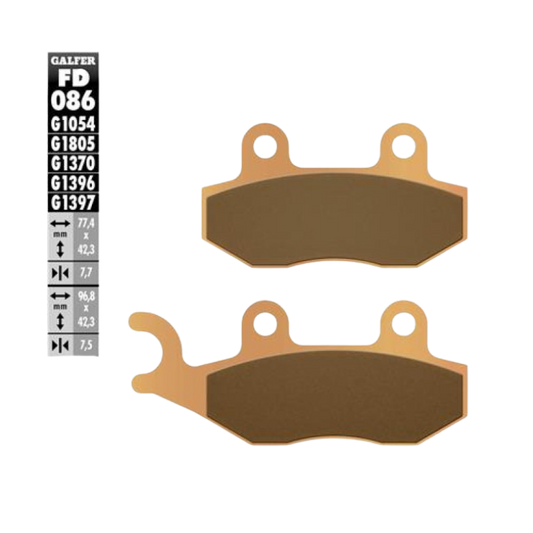
As the name suggests, sintered brake pads are made by compacting and sintering metallic powders along with other materials.
This creates a hard and durable friction material that can provide strong braking performance and good consistency at higher temperatures.
They are commonly used on sport, adventure, touring and other motorcycles that place higher demands on their braking systems.
If you ride a motorcycle at high speeds, travel long distances, carry bags, climb hills, or ride aggressively in general, then sintered brake pads can be a suitable choice, provided they are specified for your motorcycle.
Having studied the differences between organic and sintered brake pads at the material level, let’s take a closer look at the differences between the two types of brake pads.
Difference Between Organic and Sintered Brake Pads
Organic brake pads generally use a softer friction compound compared to sintered pads.
As a result, we get several differences, namely:
- Grip and initial bite
- Longevity
- Response to heat
- Noise
- Behaviour in wet conditions
Organic brake pads can have a softer and more progressive feel compared to sintered ones, while sintered pads often provide a stronger initial bite and more consistent friction under higher temperatures.
It is essential to understand that neither organic nor sintered brake pads are automatically better or worse; it all depends on the individual motorcycle, the brake system, and how it is ridden.
One rider will be delighted with the organic brake pads, while the other will prefer the sintered ones.
The feeling of the brakes will be important to many riders. The feel is very personal and is unique for each rider, but we can single out several general characteristics.
How Do the Brakes Feel?
Some like it progressive, some – sudden, some – gentle, and some – firm. Some prefer organic, and some – sintered brake pads.
If you are a city rider, then organic brake pads may provide the softer and more progressive feel that some riders prefer. However, many motorcycles used mainly in cities are also designed to use sintered pads.
On the contrary, if you are a performance rider, then sintered brake pads may provide the stronger initial bite and heat performance that you are looking for.
Again, it all depends on the individual and the motorcycle.
Heat Resistance
When it comes to high-temperature performance, sintered brake pads generally have an advantage over many organic compounds.
Every time you slow down, heat is generated in the braking system. During normal city riding, you may not notice much difference between the two types of brake pads.
However, if you often ride uphill, travel long distances, ride on the highway, carry additional weight, or brake aggressively, the brakes can experience much higher temperatures.
In these conditions, the friction characteristics of the brake pads become more important.
It is essential to understand that sintered brake pads generally maintain their friction performance well at higher temperatures and can offer good resistance to brake fade.
As a result, performance riders who regularly place higher demands on their brakes often prefer this type of brake pads.
Brake Pad Durability
Organic brake pads generally wear faster than sintered pads, although actual pad life depends on the specific compound, motorcycle, riding conditions and riding style.
In addition, of course, the durability of the brake pads also depends on the rider.
A rider who rides gently in the city may get much longer brake pad life than an aggressive rider who attacks both hills and speeds.
The same applies to touring; a rider who tours may use the brakes more because of the increased load, speed on the highway, slopes, and sometimes a passenger.
In other words, it does not matter which type of brake pads the rider has: his style of riding, motorcycle weight, passenger and road conditions will all affect their durability.
So, do not judge the durability only by the kilometres, but also by the way the motorcycle is ridden.
Performance in Wet Weather
When it comes to wet weather, the performance of brake pads depends on the specific pad compound, brake disc, motorcycle and riding conditions.
Some sintered compounds can provide consistent friction in wet conditions, but it would be incorrect to say that every sintered pad will always perform better in the rain.
If you often find yourself on the road in bad weather, or, for example, you tour and cannot control the weather, then choosing a quality brake pad that is specified for your motorcycle and riding conditions is particularly important.
Noise and Dust
As mentioned earlier, organic brake pads are often quieter and can provide a softer feel at the lever.
Sintered brake pads, on the contrary, can sometimes produce more noise, including squeaking at low speeds, depending on the pad compound, disc condition and motorcycle.
This does not necessarily mean there is a problem.
However, if you notice a sudden change in braking noise, grinding, metallic scraping or anything unusual, then it’s time to take your motorcycle to the service and have the brakes checked.
Impact on the Brake Disc
In many applications, organic brake pads can be less aggressive towards the brake disc, while some sintered compounds can contribute to more disc wear.
However, this depends on the motorcycle, the specific pad compound, the disc material, the manufacturer, and the style of riding.
This does not mean that sintered pads are bad. They are widely used because of their braking performance and durability.
If the disc itself is damaged, then a good pair of organic brake pads will not solve the problem: the disc and brake pads work together, and the condition of the disc also has a significant influence on braking performance.
You can explore motorcycle brake discs when replacing or servicing your braking components.
Which is better for city driving, organic or sintered brake pads?
If you want to ride in the city, then organic brake pads may be a good choice for you if they are approved for your motorcycle. They can offer a softer feel at the lever and can work well for a calmer style of riding.
Of course, they can be particularly suitable for some lighter motorcycles and everyday riding.
On the other hand, if your style of riding in the city involves a heavier motorcycle, frequent braking or more aggressive riding, then sintered brake pads may be a better choice, provided they meet the manufacturer's specifications.
Which is better for performance riding, organic or sintered brake pads?
If you want to ride more aggressively, if you want to feel the speed on the weekends, if you often ride on the highway and slopes, if you ride a sport or superbike, then sintered brake pads can be a great choice for you.
They generally offer strong initial bite and good friction stability at higher temperatures.
As mentioned earlier, it all depends on the individual and the motorcycle. If you are a performance rider but you like a softer brake feel, then organic brake pads may still suit your preferences if they are approved for your motorcycle.
In general, everything boils down to your preferences and the characteristics of the motorcycle you ride.
What should touring riders choose, organic or sintered brake pads?
Touring riding can place significant demands on the brakes.
Long-distance riding, bags, a passenger, the highway, slopes, and varying weather are some of the factors that touring riding can involve, and each can affect braking requirements.
In addition, long-distance riding can involve repeated braking, particularly on mountain roads or when riding with additional weight. This makes it important to choose the right brake pads.
As mentioned earlier, sintered brake pads generally offer good high-temperature friction stability and can be a suitable choice for motorcycles used in demanding conditions.
They can also provide consistent braking performance in changing conditions, depending on the specific compound.
So, the conclusion is, do not choose the cheapest or the most expensive brake pads. Choose the right ones for your motorcycle, your style of riding, and the roads you ride on.
Some riders believe that the cheapest possible brake pads are the best solution, while some are firmly convinced that only the most expensive ones are worthy of their motorcycles.
Both approaches can be wrong since the best choice is the one that suits the individual, their motorcycle, and the roads on which they ride.
A cheap, poorly manufactured brake pad can compromise braking performance, while an expensive but unsuitable brake pad may not work correctly with your motorcycle's braking system.
It is essential to pay attention to detail when choosing brake pads, namely: what the manufacturer recommends, for which year and model of the motorcycle they are suitable, whether they are recommended for the front or rear brakes, and whether they meet the required specifications.
Time to change the brake pads
It is time to change the brake pads before they are completely worn out.
Some signs that the brakes need attention include:
- The brake lever feels different from normal.
- The stopping distance has increased.
- You hear unusual or persistent noises from the brakes.
- The brake pad friction material is close to or below the manufacturer's minimum thickness.
- The brake feels weak, inconsistent or unusually soft.
If possible, it is best to change the brake pads before they are completely worn out so as not to damage the disc itself.
In other words, do not wait for the moment when metal grinds against metal. If the brake pad backing plate contacts the disc, the disc can also be damaged and may require replacement.
You can find motorcycle brake pads for different motorcycle applications at Baycity Powerparts.
Final thoughts
Organic brake pads can be a good choice for those who want to enjoy a calmer ride and experience a more progressive brake feel, while sintered brake pads are often preferred by riders who place higher demands on their braking system.
Which is better depends on the motorcycle, the road, the way of riding, and the individual rider.
If you ride a light motorcycle and spend most of your time on the road in the city, then organic brake pads may suit you very well, provided they are recommended for your motorcycle.
On the other hand, if you ride aggressively and at high speeds, if you ride heavier motorcycles up hills, or if you prefer the feel of sintered brake pads, then sintered ones may be better suited to your needs.
The most important thing is to follow the motorcycle manufacturer's recommendation and choose brake pads that are designed for your specific braking system.
For riders looking for sintered brake pads, organic brake pads, brake discs, and other motorcycle spare parts, explore the range available at Baycity Powerparts.